Blade Shapes
Shape names describe a profile, not a quality tier. A gyuto is not better than a santoku, it is longer and more curved. Most of the names below overlap heavily, and several are marketing categories that different makers apply inconsistently. Treat the names as a starting filter, then look at the actual specs and photos.
How to read a profile
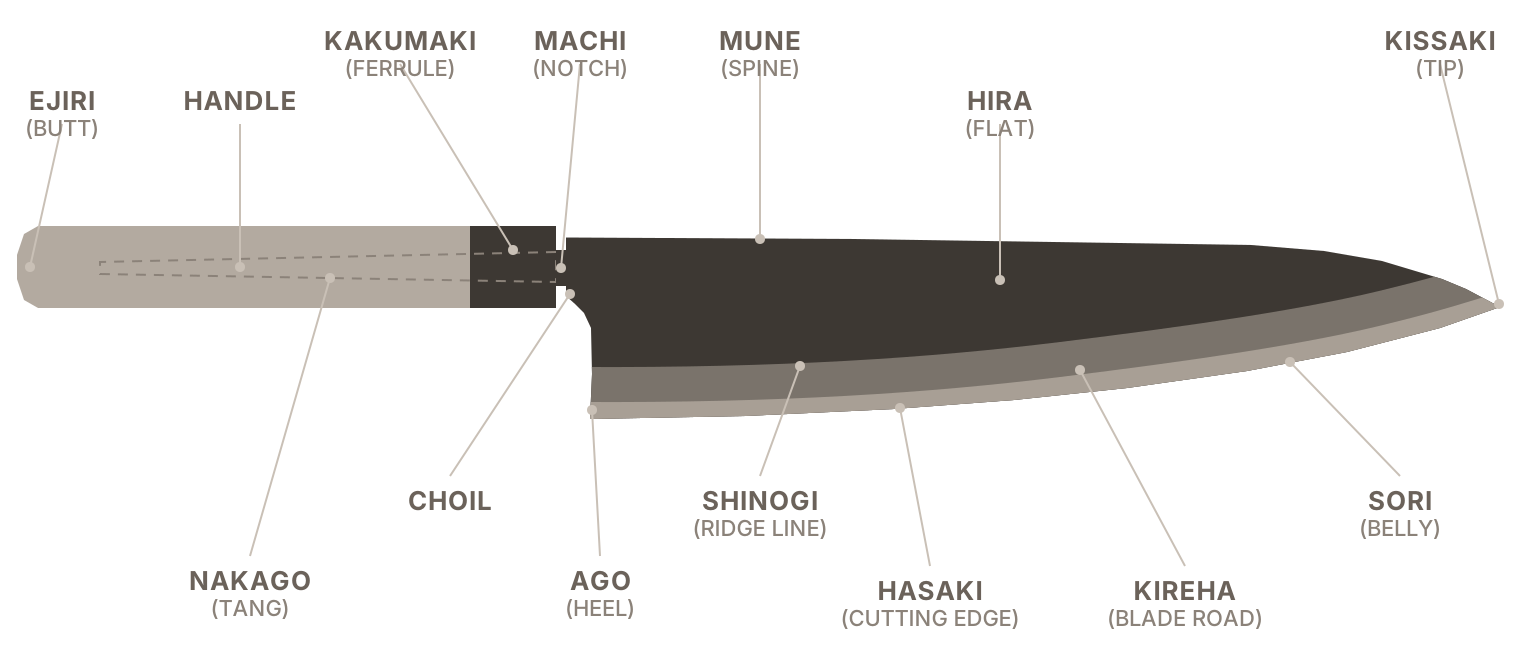
Four things determine how a shape behaves. Everything else is detail.
Edge curvature. A flat edge sits on the board along its whole length and rewards push cutting and tap chopping. A curved edge (belly) rewards rocking and makes it easier to draw the tip through a cut. Most Japanese general-purpose shapes are flatter than their Western equivalents, which is the single biggest reason a gyuto feels different from a chef's knife of the same length.
Tip geometry. A gradual, low tip (gyuto, sujihiki) gives you fine point control and good board contact. A sheepsfoot or hoof tip (santoku, nakiri) trades tip work for a fully flat edge. A reverse tanto or k-tip (bunka, kiritsuke, honesuki) gives a strong, precise point because the spine drops down to meet the edge rather than the edge sweeping up.
Blade height. Taller blades give knuckle clearance and a bigger face for scooping, but they wedge more in dense produce unless the grind is good. Nakiri and chuka bocho are the extremes.
Bevel. Double-bevel knives are ground on both sides and are symmetric in the cut. Single-bevel (kataba) knives are ground on one side with a hollow (urasuki) on the flat back. They cut with a steering bias, are handed (right or left), and take real practice and real sharpening skill. Every traditional Japanese shape below that is marked single-bevel carries that cost.
Japanese shapes: quick reference
| Shape | Typical length | Bevel | Profile and tip | Primary use |
|---|---|---|---|---|
| Gyuto | 180 to 270 mm | Double | Curved belly, fine tip | General purpose |
| Santoku | 165 to 180 mm | Double | Flat, sheepsfoot tip | General purpose, home |
| Bunka | 165 to 195 mm | Double | Flat, reverse tanto tip | General purpose with tip work |
| Bannou | 150 to 180 mm | Double | Varies by maker | General purpose (catch-all name) |
| Nakiri | 165 to 180 mm | Double | Flat, tall, square ends | Vegetables |
| Petty | 120 to 150 mm | Double | Small, curved, fine tip | Small work, in-hand tasks |
| Kiritsuke | 210 to 300 mm | Either | Flat, angled k-tip | Slicing and precision (single-bevel) |
| Chuka bocho | 180 to 220 mm | Double | Rectangular, very tall | General purpose, high volume prep |
| Sujihiki | 240 to 300 mm | Double | Long, narrow, low tip | Slicing cooked and raw protein |
| Honesuki | 145 to 165 mm | Double (often asymmetric) | Triangular, k-tip, thick spine | Poultry breakdown |
| Garasuki | 180 mm | Double (often asymmetric) | Honesuki profile, larger and heavier | Larger poultry and meat |
| Hankotsu | 145 to 150 mm | Double (often asymmetric) | Straight edge, stiff, pointed | Boning hanging carcasses |
| Deba | 150 to 180 mm | Single | Thick spine, tall heel, drop tip | Breaking down fish |
| Funayuki | 150 to 210 mm | Usually double | Thin, mild belly, pointed | Fish and general prep |
| Yanagiba | 240 to 330 mm | Single | Long, narrow, pointed | Sashimi slicing |
| Takohiki | 240 to 300 mm | Single | Long, narrow, squared tip | Sashimi slicing (Kanto style) |
| Usuba (Edo) | 165 to 210 mm | Single | Tall, flat, square tip | Professional vegetable work |
| Kamagata usuba | 165 to 210 mm | Single | Tall, flat edge, sickle tip | Vegetable work with tip detail |
| Mukimono | 150 to 180 mm | Single | Small, flat, pointed | Decorative peeling and carving |
| Udon kiri | 240 to 330 mm | Usually single | Long rectangle, no curve | Cutting noodle dough |
Japanese shapes: general purpose
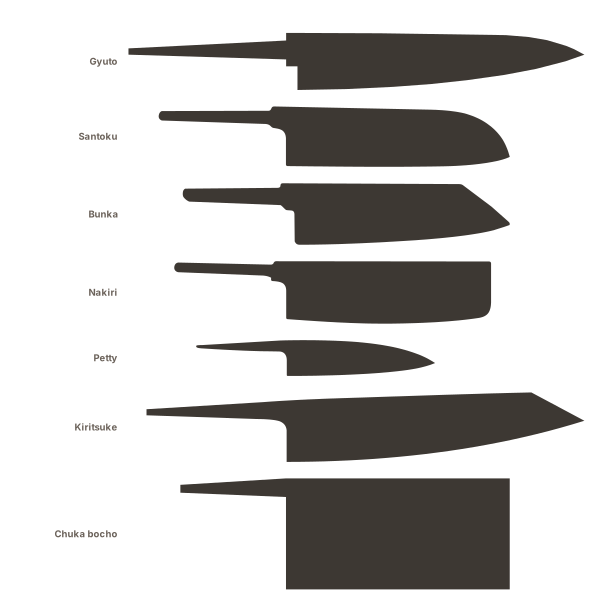
Gyuto. The Japanese take on the Western chef's knife, and the default recommendation for most people. Compared to a German chef's knife of the same length it is thinner, lighter, harder, flatter through the middle, and has a finer tip. The belly still supports rocking, but the flatter section rewards push cutting. Common lengths are 210 mm and 240 mm; 240 mm is the standard professional size and is a lot of knife for a small home board. Good at nearly everything soft, poor at bone and cartilage.
Santoku. The short, flat, tall general-purpose knife most Japanese home cooks own. The name means roughly "three virtues," usually read as meat, fish, and vegetables. The edge is close to flat with a sheepsfoot or hoof tip, so it push cuts cleanly and is easy to keep on the board, but the blunt tip limits fine point work. A 180 mm santoku covers most of what a 210 mm gyuto does in less counter space. Note that santoku and bunka are related but not the same knife, despite frequent conflation online.
Bunka. Effectively a santoku with a reverse tanto (k-tip) instead of a rounded tip, usually slightly taller and flatter as well. You keep the flat push-cutting edge and gain a strong, precise point for scoring skin, working around joints, and detail work. Sizes cluster at 165 mm and 180 mm. Opinions differ on whether the k-tip is genuinely more useful or mostly aesthetic; if you never use your tip, a santoku is the simpler choice.
Bannou. A catch-all name rather than a defined profile. It translates roughly as "ten thousand abilities" and is used by many regional makers for their volume-selling all-rounder, typically in the santoku and bunka size range. Two bannou from different makers can be very different knives. If you are shopping this category, search santoku and bunka alongside it, and judge by the specs and photos rather than the name.
Nakiri. The double-bevel vegetable knife: tall, thin, flat edged, squared at both ends. The flat edge contacts the board along its full length so cuts finish cleanly without the accordion effect a curved edge produces. The height gives knuckle clearance and a large face for scooping. It cannot do tip work at all, and thin blades in the 165 mm to 180 mm range can wedge in dense root vegetables if the grind is poor. The single-bevel professional equivalent is the usuba.
Petty. A small utility knife, from the French "petit." Sizes run from about 75 mm to 180 mm, with 120 mm to 150 mm the useful range. Below roughly 120 mm it is an in-hand paring knife; above that it is a board knife for shallots, garlic, herbs, and small proteins. Practically, this is the knife you grab without thinking. Larger petty (150 mm and up) blur into a small gyuto.
Kiritsuke. The traditional kiritsuke is a long, flat single-bevel knife with an angled clipped tip, functionally a hybrid of yanagiba and usuba, and it demands the technique both of those require. It is widely reported as a head chef's knife in traditional Japanese kitchens, though this is repeated far more often than it is documented. What most retailers now sell as a kiritsuke is a double-bevel "k-tip gyuto," which is a normal gyuto with the angled tip and none of the single-bevel difficulty. Check which one you are looking at before buying.
Chuka bocho. The Japanese-made Chinese-style cleaver, literally "Chinese kitchen knife." Tall rectangular blade, commonly 180 mm to 220 mm long and around 100 mm tall. It is not a meat cleaver: it is thin, hard, and sharp, meant for vegetables, boneless protein, herbs, and crushing aromatics, not for bone. The face is unmatched for scooping prepped food off the board. The height takes adjustment and it needs a large board.
Japanese shapes: protein and butchery
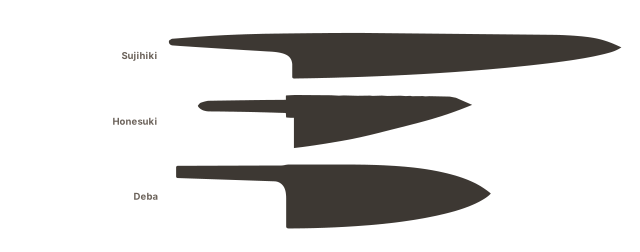
Sujihiki. The double-bevel slicer, essentially a long, narrow, low-tipped gyuto with minimal belly. Narrow width means less surface friction, so a single long draw stroke through a fillet or roast comes off clean instead of tearing. Common at 240 mm and 270 mm. It is a specialist: too narrow for board chopping, no knuckle clearance, and the length is unwieldy for anything else. The single-bevel counterpart for raw fish is the yanagiba.
Honesuki. The Japanese poultry boning knife: short, triangular, with a thick spine, a stiff blade, and a k-tip. It is stiff where a Western boning knife is flexible, which is the key difference. The stiffness and thick spine let it drive through cartilage and joints, and the strong point works into tight spaces. Often ground asymmetrically. Not for cutting bone.
Garasuki. The same profile as a honesuki but larger, thicker, and heavier, developed for kitchens breaking down whole chickens in volume. Usually around 180 mm. Everything true of the honesuki applies with more mass behind it, which helps on larger birds and cuts of meat and hurts if you want a nimble knife.
Hankotsu. A stiff boning knife with a straight edge rather than the honesuki's triangular profile, designed for working hanging carcasses with a reverse grip. Short blade height lets it turn along bone and connective tissue. Some are sold unsharpened or barely sharpened for edge strength on rough work. For poultry, a honesuki is the better tool.
Deba. The single-bevel fish breakdown knife, thick through the spine and heavy at the heel. It is built to take heads off fish and split through the small bones and collar of a whole fish using the heel, then use the tip for finer separation. It should not be used on heavy bone. Sizes run 105 mm to 240 mm; 165 mm handles most home-sized fish. The ajikiri is a small thin deba for small fish such as mackerel. This is a demanding knife to sharpen well.
Funayuki. A thin, light general-purpose knife historically associated with fishermen preparing catch on board, and the name is often translated as something like "boat going." Usually double-bevel, though single-bevel versions exist, in roughly 150 mm to 210 mm. In practice, funayuki is a loosely applied regional name and the shape varies widely between makers, from a small deba-like blade to something close to a santoku or petty. Verify the actual geometry rather than relying on the name.
Japanese shapes: single-bevel traditional
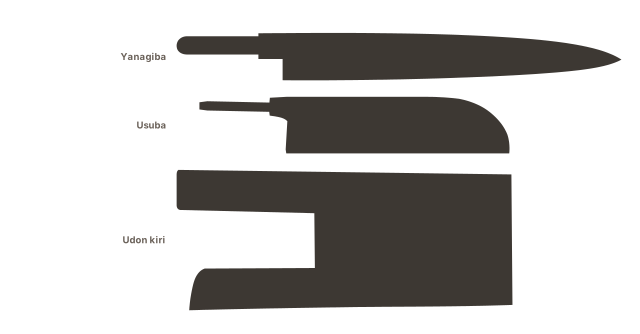
Yanagiba. The classic sashimi slicer: long, narrow, single-bevel, with a pointed willow-leaf tip. It is used with one long pull stroke, not a saw, and the flat back with its urasuki hollow lets the edge glide instead of tearing the cut face. The name yanagiba means willow leaf; shobu is an alternate name for the same knife. It is associated with the Kansai region (Osaka and Kyoto), while the squared-tip takohiki is the Kanto counterpart. Sources disagree on which region uses which name, so treat the naming as contested. Common at 270 mm and 300 mm.
Takohiki. The Kanto-region sashimi slicer: same job as a yanagiba, but with a straight edge and a squared-off tip instead of a point. Usually thinner and narrower than a yanagiba. The name literally reads as "octopus pulling," but the connection to octopus is commonly reported rather than settled, and it is used for sashimi generally. The sakimaru takohiki is the rounded-tip variant.
Usuba. The professional single-bevel vegetable knife, and the reason the nakiri exists in its double-bevel form. Tall, thin, flat edged, ground on one side with a hollow back. The Edo or Kanto style has a square, blunt tip and is the version most commonly exported. It is built for katsuramuki, the rotary peeling of a daikon into one continuous translucent sheet, which the flat single-bevel face makes possible in a way a wedge-ground double bevel does not. Thin edge, easily chipped, high skill demand.
Kamagata usuba. The Kansai-style usuba, named for its sickle-shaped (kama) profile: the spine curves down to meet the edge at a point. It does everything the Edo usuba does, plus tip work, which makes it the preferred style for kazarigiri, the decorative carving used in kaiseki presentation. The pointed tip is fragile. Note that some retailers use "kamagata" for unrelated small knives; in standard usage it refers to this usuba.
Mukimono. A small, thin, single-bevel knife for intricate vegetable peeling and carving. Flat like a usuba but much smaller and pointed, so it works as a detail tool for garnish work rather than a general vegetable knife. Highly specialized and rarely a first or second purchase.
Udon kiri. A dedicated noodle knife: a long straight blade with no curve, on a handle mounted so the blade sits well below it, letting the edge come fully down to the board on every cut without the handle striking it. Soba and other regional variants differ mainly in blade-to-handle proportion. Useless for anything but cutting rolled dough.
Practical notes on overlap
Several of these names describe knives close enough that anyone shopping one should look at all of them. Santoku, bunka, and bannou overlap heavily, separated mostly by tip shape and by maker preference rather than by function. Nakiri and usuba do the same job with different bevels. Sujihiki and yanagiba are both long slicers, one double-bevelled and one single. Honesuki and garasuki are the same profile at two sizes.
Where a name marks a real functional difference, it is almost always bevel (single versus double) or stiffness. Those two axes matter more than the vocabulary does.
Names are also used loosely. Bannou means "all-purpose" and different makers apply it to different profiles. Kiritsuke covers both a traditional single-bevel slicer and a modern double-bevel gyuto with an angled tip, which are very different knives. Read the specs rather than the name.
Sources: the r/TrueChefKnives community wiki compiled by u/ole_gizzard_neck; JapaneseChefsKnife.com; Knifewear; SharpEdge; Bernal Cutlery; Hocho-Knife; Japanese Knives Guide; zknives.